They arrived with resources. Durango gave them a reason to return.
Each journey began with a need and the determination to find something useful—a computer, a teacher, a new connection. Each welcome deepened the relationship. One trip inspired another, until the journeys became a bridge.
One student gave the bridge its first destination.
At a Morton East YTC meeting, Jesús C. told the group about his grandfather in Durango. His grandfather had never seen a computer. For students already refurbishing machines for Cicero families and community programs, the next question became personal: could they carry what they had learned back to the communities their own families came from?
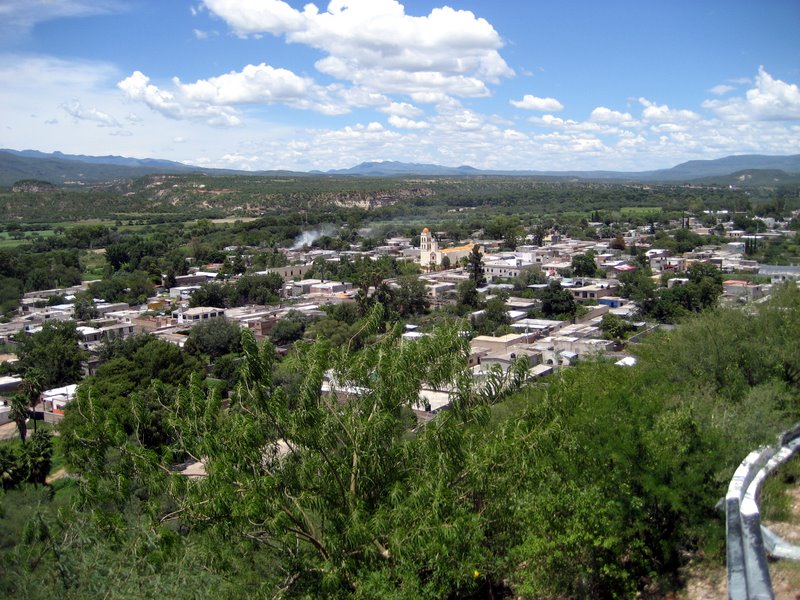
In July 2000, Jesús traveled to Mexico with his Morton East classmates, YTC adults, computers, medical supplies, and seeds. In El Presidio, the group stayed in his grandfather's barn. The accommodations were humble; the idea was not. Young people could deliver technology, teach others to use it, and build a relationship strong enough to make the journey again.
The trip established the pattern that would shape YTC in Mexico: technology opened the door, students became teachers, and families on both sides made the work possible.
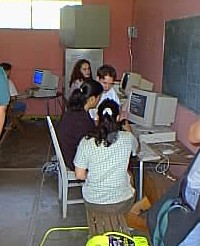
July 2000. Bryan G. teaches the first class on donated computers in Mexico. David Finkel remembers Bryan as the only non-Mexican participant on that first trip.
What they carried—and what they began.
The July 2000 trip record is filled with practical things: computers for three schools, medical supplies, seeds, an agricultural educator, and students prepared to install the labs and teach.
Behind that list was an entire community making the journey possible—families, schools, neighborhood organizations, donors, and young people willing to carry useful resources where they were needed.
YTC described the goal as “building community through technology transfer.” On the ground, it meant sleeping in Jesús’s grandfather’s barn, teaching the first computer class, working beside local families, and discovering that useful work could become a lasting relationship.
Then they came back. Year after year, that decision became the bridge.
The bridge changed what it could carry.
It began with practical resources moving south. Then students crossed in both directions, projects continued between trips, and the teaching itself moved online. Today the bridge carries robotics, engineering, Indigenous-language curriculum, and young people prepared to teach the next group.
2000The first road south
A practical idea becomes an adventure.
A small group of Morton East students traveled with refurbished computers, medical supplies, seeds, an agricultural educator, and adults who knew rural Durango. They stayed in Jesús C.’s grandfather’s barn, installed the first labs, taught the first classes, and proved that student skill could answer a real community need.
One hundred computers changed what seemed possible.
Eight students and five adults worked in Santiago Papasquiaro and Tepehuanes. In Santiago, students stayed up through the night to prepare a cultural-center lab, then taught more than 300 young people in rotating classes over two days. An aquaculture demonstration offered a water-saving idea during a long drought, and the governor received the delegation.
Funding delays pushed the journey to Thanksgiving and reduced the group. In an unheated Tepehuanes motel, the welcome was warmer than the rooms. The team installed 50 computers in the public libraries of Santiago and Tepehuanes, taught roughly 200 students, distributed Spanish-language curriculum, and secured commitments for a YTC chapter and live online collaboration.
Fifty more computers and classes for more than 200 students continued the work, but the deeper change was personal. COBAED 10 became an institutional partner, Chicago students began staying with Durango families, and shared projects in water quality and environmental learning gave students work to continue after the travelers went home.
Technology became a stage for every kind of talent.
Twenty-four students and thirteen adults worked across Santiago, Tepehuanes, and Santa María del Oro. The 100-computer delivery came with safe-water research, filmmaking, folkloric dance, and a youth-development seminar attended by hundreds. The farewell presentation drew an audience of about 500.
Seventeen students and nineteen adults delivered another 100 computers. For the first time, Northwestern University’s Collaboratory was used internationally: students in Mexico and Chicago built a bilingual online report together. Forestry research, filmmaking, and computer work gave the partnership subjects larger than the equipment itself.
Nineteen students and fifteen adults expanded the work to Santiago, Tepehuanes, Santa María del Oro, Nuevo Ideal, and Mezquital. Students linked several Durango communities with Chicago in a live online session, made documentaries, designed websites, practiced peer mediation, and completed YTC’s first wilderness leadership experience.
The program learned it could travel without its founder.
Twelve students and fifteen adults carried 100 computers to four municipalities. The newsletters preserve the journey through Angel M.’s and Joseph C.’s eyes, while students trained local film crews, studied birds and the environment, built websites, and collaborated online. David did not make this trip; the bridge held because other leaders stepped forward.
“Joseph practices Spanish.” One student-sized moment from the 2007 trip record.
2008The ninth journey
Six Durango municipalities were now connected.
Twenty-three students and ten adults worked in Santiago, Tepehuanes, Nuevo Ideal, and Mezquital, while computers also reached Coneto de Comonfort and Canatlán. Birds Without Borders, filmmaking, environmental leadership, web design, and live collaboration filled the week. After this ninth trip, safety concerns ended the annual road missions—but not the relationship.
Safety concerns stopped the annual road missions, but computers continued moving south and Durango groups continued traveling north. The people and institutions on both sides kept the relationship alive while its next form was taking shape.
El Siglo de Durango documented 33 students and six teachers from eight campuses traveling to Chicago for classes, cultural presentations, community visits, and technology competition. The paper described an exchange then entering its fourteenth year.
Students who had learned robotics in the Morton East clubroom began teaching COBAED and CBTa classrooms online—in Spanish. The bridge was no longer dependent on moving people or equipment; knowledge could travel every week.
2024–25Mexico leads
The bridge now carries teachers, robotics, and leadership.
At Universidad Tecnológica del Mezquital, students from Indigenous communities applied robotics in state competition, taught rural learners of their own, and helped translate modules into Audam, O'dam, and Huichol. What began as technology transfer had become a locally rooted teaching network.